
June 08, 2026
What Stops the Scroll and Starts the Sale: Visual Storytelling for Home Builders and Master-Planned Communities
There is a moment, usually early in a community brand refresh, when a client looks at their existing photography library and realizes they have hundreds of images and almost no story. The homes are sharp, the amenities are well-lit and the landscaping looks appropriately lush. And yet nothing in those images communicates what it actually feels like to live there. They don’t show who the neighbors are, what a Tuesday afternoon looks like, whether the kids can walk to a park or whether grandparents gather anywhere in particular on a Sunday morning. Yes, the photography documents the product, but the story is entirely missing.
Visual storytelling is the discipline that closes that gap, and for home builders and master-planned community developers, the stakes of closing it are higher than many organizations fully appreciate. Before a prospective home buyer completes a lead form, tours a model or speaks to a sales counselor, they have already formed a powerful first impression of a community based almost entirely on what they have seen. The photography, the video and the imagery woven through every digital and physical touchpoint is the brand experience for most prospects, most of the time. How those visuals are conceived, directed and curated determines not just whether someone clicks through a listing, but whether they feel any emotional pull toward a place at all.
Executed well, visual storytelling transforms a real estate development into a place people want to belong to. Executed poorly or not executed at all leaves even an exceptional community looking indistinguishable from every other development within a fifty-mile radius.

Why Home Buyers Buy Feelings First
The cognitive science behind home buying decisions has been well-documented across decades of consumer research: purchasing a home activates emotional processing long before rational evaluation kicks in. According to the National Association of Realtors’ 2024 Profile of Home Buyers and Sellers, the first step home buyers take in the search process is overwhelmingly to look online for properties, and they spend a median of 10 weeks in active digital research. During that research phase, photography carries more weight than any other content element: 41% of home buyers identified photos as the most valuable content on websites, outranking detailed property information and floor plans.
This matters for a specific reason that gets underappreciated in how home builders approach their marketing: photography and video are not the final step in a marketing process, the visual garnish added to a campaign after the strategic work is done. They are the primary medium through which home buyers form their emotional relationship with a community or home. A brand strategy that does not extend into a coherent, intentional visual narrative is only half-finished, regardless of how well the positioning is written or how thoughtful the naming was.
The communities that convert the highest percentage of their online traffic to registered prospects and appointments are likely the ones that have invested in visual content that makes people feel something, and feel it quickly.
What Visual Storytelling Actually Means, and What It Doesn't
The phrase gets used loosely enough that it is worth establishing what true visual storytelling requires, as distinct from simply having good photography.
Visual storytelling is not the same as visual documentation. Documentation captures what exists: the clubhouse, the pool, the streetscape, the kitchen finishes. Documentation has value because home buyers need to see the product, but it answers only the question of what. Visual storytelling answers why it matters, who it is for and what kind of life it enables. A photograph of a pool tells a prospective home buyer that a pool exists. A photograph of three generations laughing together in that pool on a late summer afternoon tells them something about who they could become if they chose to live there.

Visual storytelling is also not the same as lifestyle photography in the generic sense. The residential real estate industry has spent two decades shooting variations on the same visual vocabulary: attractive, ambiguously-aged models in neutral clothing, staged kitchens with artful produce and golden-hour silhouettes against skylines. Those images are competent and broadly inoffensive, which is precisely the problem. They belong to no specific place, evoke no particular community culture and give a prospective home buyer no reason to feel that this community understands them.
Authentic visual storytelling is specific. In fact, the specificity is the point. When a prospective home buyer sees photography that reflects the actual demographic character of a community, the actual activities available and the actual scale and rhythm of daily life in that place — when they see children who look like their children, neighbors who look like the neighbors they want, moments that mirror the life they are trying to build — the emotional response is categorically different from anything stock-adjacent imagery can produce. Specificity creates recognition, and recognition is what converts curiosity into genuine desire.
The Core Principles of Visual Storytelling Done Well
Across three decades of award-winning work, we’ve found that certain principles have consistently separated the visual storytelling that converts from the photography that simply fills a website. They are not complicated principles, but executing them requires discipline, intentionality and a willingness to invest in the process rather than treat photography as a line item to be reduced.
Start with the brand story, not the shot list.
The most common failure mode in real estate photography is treating the shoot as a logistical exercise rather than a storytelling opportunity. When photography direction begins with a shot list, the result is inevitably a disconnected inventory of assets rather than a coherent narrative. The visual language is dictated by whatever amenities or model homes happen to be ready, rather than by any considered view of what story needs to be told.
Before a camera is raised, the photography brief should be driven by brand strategy:
-
What does this community uniquely offer, and to whom?
-
What moments of life in this place communicate that offer most powerfully?
-
What emotions should a prospective home buyer feel after scrolling through this imagery, and what specific scenes will reliably produce those emotions?
A photography director who understands the brand positioning can translate those strategic answers into creative direction that makes every frame intentional rather than incidental.
Cast for authenticity, not aspiration alone.
The question of who appears in community photography is as strategically important as what they are doing. Communities that reflect the authentic demographic reality of their buyer profile in terms of age range, family composition, and racial and cultural representation, create immediate recognition for the home buyers most likely to purchase. Communities that cast for a narrow, aspirational ideal tell the majority of their prospects, subtly but clearly, that this place was not designed with them in mind.
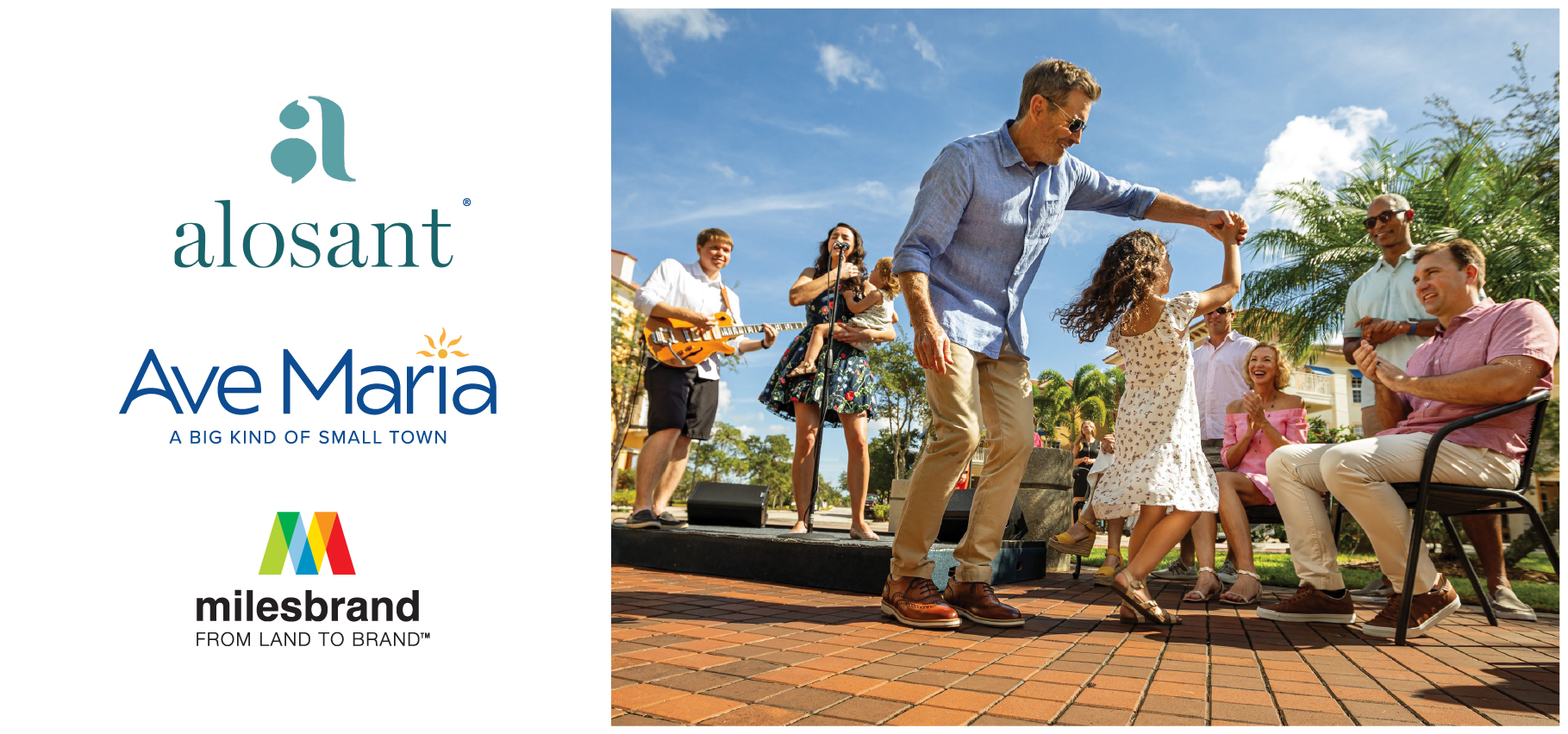
Ave Maria's recent brand photography refresh illustrates what intentional casting produces at its most powerful. Rather than working with hired talent, Ave Maria’s Real Stories campaign was built around real homeowners: actual residents sharing their lives, their connections and their love of the community through photos and videos captured on location. That decision added a layer of authenticity that directed or stock lifestyle photography, however well executed, cannot replicate. The people in the images are not performing community life, they are living it. The diversity of faces, ages and life stages across that gallery communicates, before a single word of copy is read, that this is a town where a wide range of people truly belong.
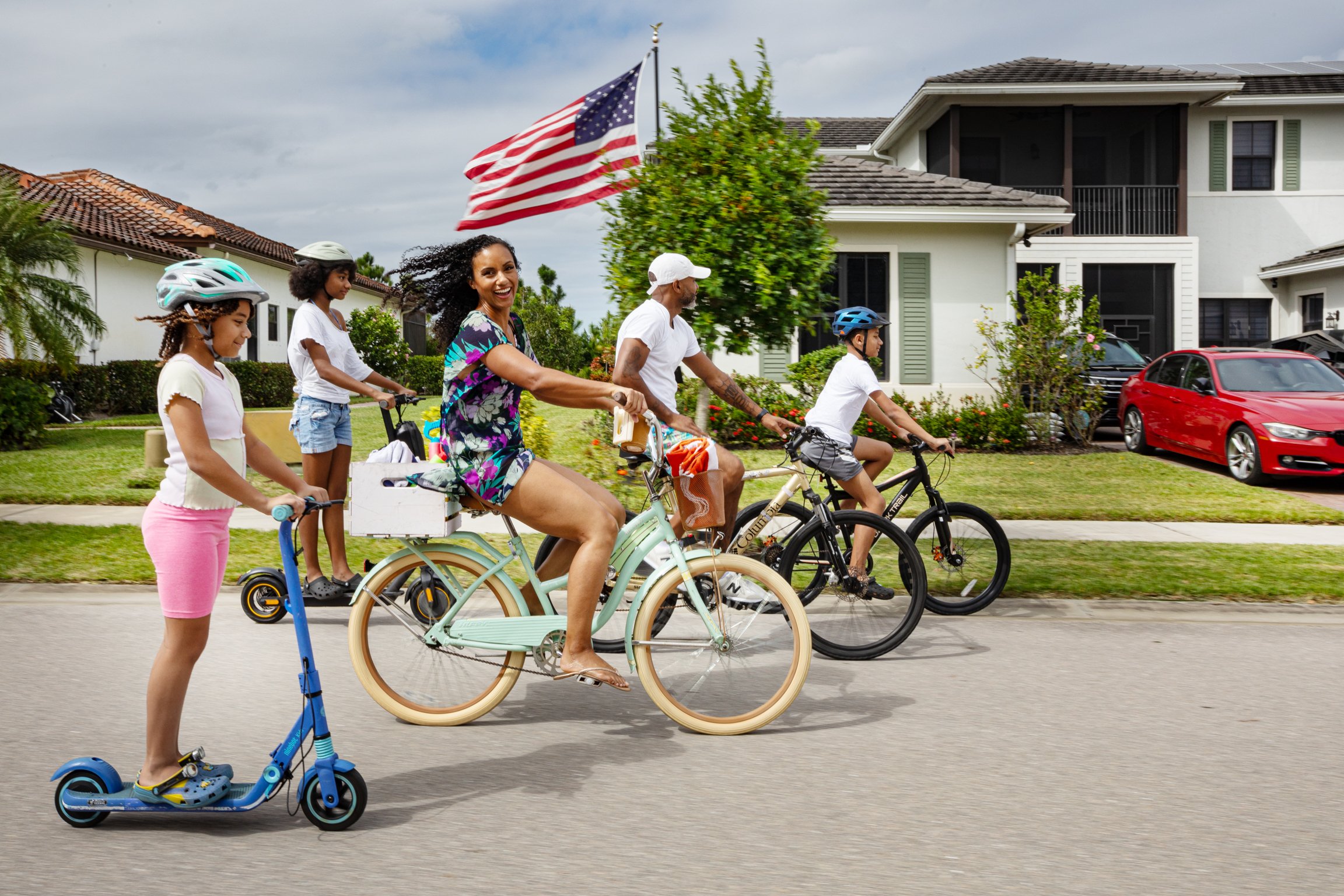
While Real Stories was conceived and launched as a campaign, the photography and video it produced functions as something more durable than campaign creative. Because the content is rooted in real residents and real moments rather than a campaign-specific concept, it translates naturally into the community’s broader brand library and is usable across social media, the website, digital advertising, the sales center and beyond, even long after the campaign itself has finished. The best storytelling campaigns work exactly this way, where the campaign is the occasion for creating exceptional original content but the content outlasts the campaign.
Capture moments over monuments.
There is a persistent temptation in community photography to prioritize the impressive over the intimate: the grand clubhouse entrance rather than the two neighbors talking on a front porch; the aerial shot of the amenity campus rather than the small group of women finishing a yoga class at golden hour; the architectural statement rather than the child shrieking down the water slide. The monumental imagery has its place, particularly for establishing scale and setting, but the moments of ordinary life lived well are what create emotional resonance.
The images that stop a scroll are almost never the ones that were easiest to plan. A grandfather lifting a grandchild in a sun-drenched backyard, captured in that specific quality of late-afternoon Florida light, communicates something about active adult community life that no amount of fitness center photography can replicate. A dance floor packed with residents at a Saturday night community event says more about social vitality than any amenity brochure. Those moments require preparation, patience and a photographer who understands that the shot they are hunting is an emotion, not a location.

Build a brand library, not a campaign.
Home builders and real estate developers frequently approach photography as a campaign asset rather than a brand infrastructure investment: they commission a shoot at launch, use those images for two or three years, and return to the well only when the photography starts to look obviously dated. The problem with this model is that the home buying path is nonlinear and multi-touchpoint, meaning a prospective home buyer may encounter a community's visual content across social media, search, email, digital advertising, print collateral and a sales center over many months. A thin photography library is depleted rapidly across those channels. The most serious home buyers notice the repetition, and those are the prospects likely close to converting.
Communities with deep, diverse visual libraries are able to maintain fresh, channel-appropriate content across the full duration of the home buying consideration period. They can tell seasonal stories, feature different resident types across different contexts and continually surface the range of experiences available in the community. That breadth of content signals to every home buyer paying attention that this is a place where life actually happens, not a stage set assembled for a weekend shoot.
Visual Consistency Across Every Touchpoint
The power of any individual photograph is multiplied when it exists within a coherent visual system. Conversely, even exceptional imagery loses much of its impact when it appears alongside visual content that contradicts its tone, demographic character or emotional register. Home builders operating across multiple active communities face this challenge acutely: without deliberate brand governance, each community's visual identity evolves independently, and the cumulative brand impression becomes fragmented.
Master-planned community developers face a related but distinct version of this challenge. When multiple builders are actively marketing within a single community, each producing their own photography and visual content, maintaining the integrity of the master brand's visual language requires explicit standards, regular oversight and a clear understanding shared by every builder partner of what the community's visual identity is trying to communicate. The master brand sets the emotional register, and builder sub-brands must operate within it, not around it.
Visual consistency does not mean visual uniformity. A great community photography library shows wide range: different seasons, different activities, different resident types and different scales from intimate to aerial. What remains consistent is the quality, the tone and the underlying emotional story. A prospective home buyer moving from a community's Instagram to its website to its digital advertising to its sales center should feel the same place at every stop, not because every image looks alike, but because every image belongs to the same story.
The Ave Maria Brand Refresh: Visual Storytelling in Practice – Real Stories
Ave Maria has been recognized as Southwest Florida's community of the year for nine consecutive years, a distinction that reflects the depth and authenticity of the community that has grown there over the past two decades. When the brand refresh brought us back to look at how to evolve the visual identity, the opportunity was not to reimagine the community's character but to tell the truth about how it had matured.
The Ave Maria story, as it exists today, is about the accumulated richness of a real town: the golfers and the families, the active adults who have found their rhythm, the young parents navigating school drop-offs, the impromptu gatherings at the neighborhood gathering spots and the organized community events that draw hundreds. The new photography and video library captures that range with a specificity and warmth that stock imagery and generic lifestyle photography simply cannot replicate: Teens in prom attire, women walking together through golden light, a packed dance floor on a Saturday night, a girl riding a water slide, families at the pool. Every image or video belongs to a place that is genuinely alive.

What makes that brand library work as a storytelling asset is not any single photograph or video but the cumulative portrait it paints: of a community that accommodates full lives across generations, where there is always something happening and always somewhere to be. A prospective home buyer spending time with that imagery does not just learn what amenities exist. They begin to imagine themselves into the story. That is the conversion moment that visual storytelling is designed to create, and it cannot be manufactured without the investment and intentionality the process requires.
Where Home Builders Underinvest and What It Costs Them
The most persistent underinvestment pattern in residential real estate visual storytelling falls into three areas, and all three are recoverable with the right strategic and creative approach.
The first is photography budget allocation. When marketing budgets face pressure, photography and video production are disproportionately targeted for reduction because most people look at them as discretionary spend, unlike media placements and digital advertising. The logic is backwards. A digital advertising campaign built around thin, generic or dated imagery loses effectiveness at every stage of the funnel. Every dollar spent on media placement is a dollar spent sending a prospective home buyer to a visual experience that fails to convert them. Investing in stronger creative assets improves the return on every other line of the marketing budget.
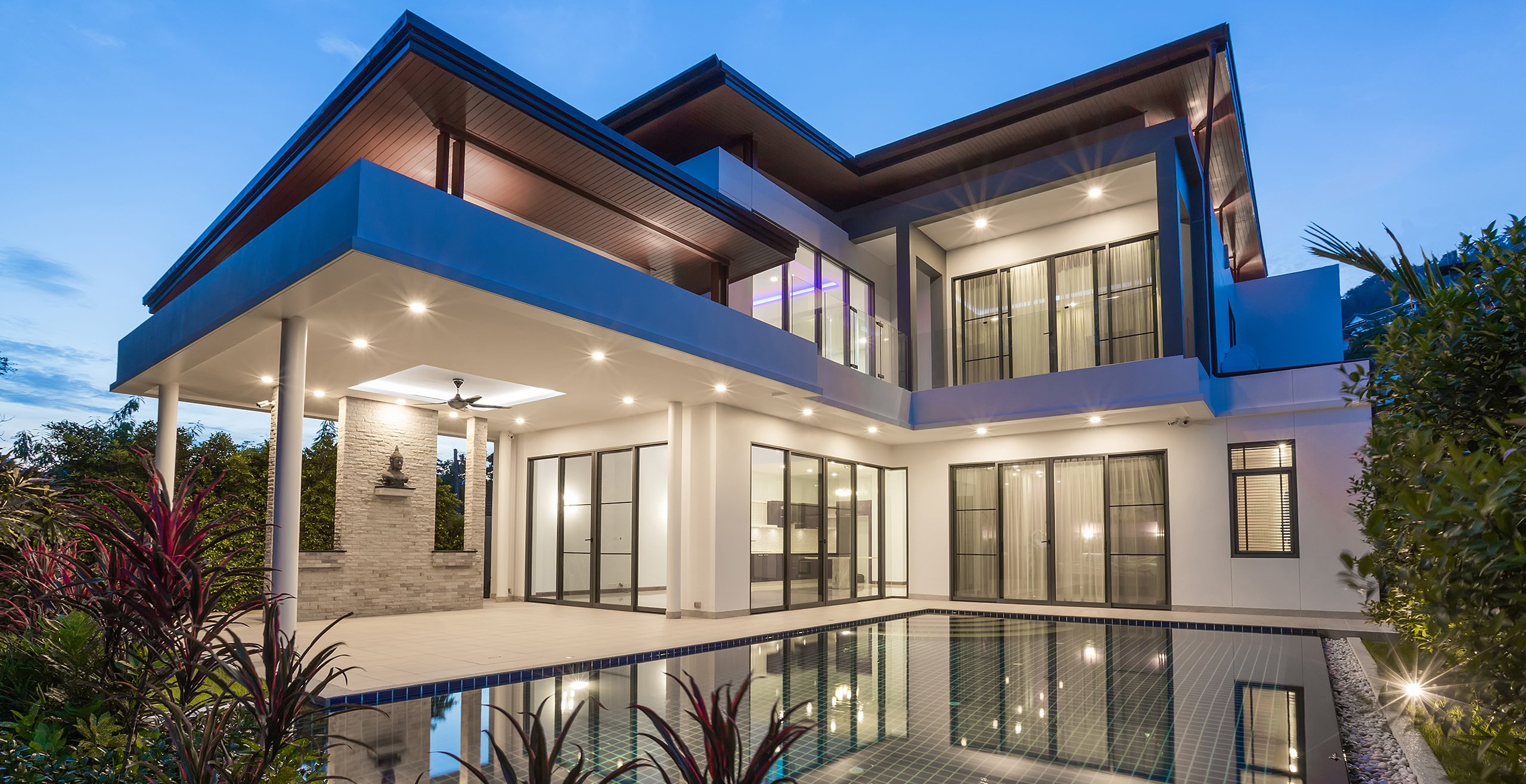
The second is the use of model photography as community photography. Model homes are a product category, not a lifestyle context. Photography that is entirely or predominantly interior-focused, however beautiful, does not tell a community story – it only tells a product story. Home builders who rely on model photography as the backbone of their community marketing are making a trade they may not realize they are making: substituting product credibility for the emotional desire that actually drives home buyer decisions.
The third is failure to refresh. A photography library has a shelf life that varies by community maturity, market positioning and the speed at which the surrounding competitive landscape evolves. A library that was exceptional three years ago may now look dated relative to what a competitor has produced, or may simply no longer reflect the community's current demographic character or amenity offering. Regular visual audits, which include assessing what the imagery communicates, who it speaks to and whether it still accurately represents what the community has become, are a basic discipline of brand stewardship that many home builders skip for years at a time.
The Visual Story Is the Brand Experience
The strongest master-planned communities in the residential real estate industry understand something that takes some home builders years to fully internalize: the physical community and the marketed community are experienced as a single thing by prospective home buyers. When those two things are misaligned, such as when the marketing imagery creates an expectation the community cannot support, or when the community is exceptional but the imagery fails to capture what makes it so, the result is always underperformance.
Visual storytelling, done with strategic intention and creative rigor, is the mechanism that aligns them. It ensures that the first impression a prospective home buyer forms of a community is the right impression: specific, emotionally resonant and accurate. That alignment is not just a marketing aspiration; across absorption cycles, it is a measurable business advantage.
The communities that tell their story best, with imagery that is honest, beautiful and alive, are the ones home buyers remember, return to and ultimately choose.
Ready to evaluate what your current visual library is — and isn't — communicating? Milesbrand has spent more than three decades helping home builders and master-planned community developers find and tell the story that is already in the land. Let's talk about what yours could become.
Frequently Asked Questions: Visual Storytelling for Home Builders and Master-Planned Communities
What is visual storytelling in real estate marketing?
Visual storytelling in real estate marketing refers to the strategic use of photography, video and imagery to communicate the emotional experience of living in a community, not merely its physical features. Where traditional real estate photography documents what exists, like the amenities, the architecture or the finishes, visual storytelling communicates who the community is for, what daily life there looks and feels like and what kind of belonging it enables. For home builders and master-planned communities, effective visual storytelling is the primary mechanism through which prospective home buyers form an emotional connection to a place before they ever visit it in person.
How does visual storytelling affect home buyer conversion rates?
Visual storytelling affects home buyer conversion rates by accelerating and deepening the emotional connection that drives purchase decisions. Home buyers who encounter community photography that is specific, authentic and emotionally resonant are more likely to move from digital research to registration, from registration to appointment and from appointment to contract. Home builders with strong visual libraries also tend to see improved quality of registered prospects, because the specificity of effective visual storytelling acts as a self-selection mechanism: home buyers who strongly identify with the imagery are more likely to be genuinely well-matched to the community's offering.
What makes original community photography different from stock lifestyle photography?
Community photography is distinct from generic lifestyle photography in that it is specific to a single place and the people who actually live or would live there, rather than broadly aspirational and universally applicable. Generic lifestyle photography uses models, staged environments and art-directed scenes that could belong to any development, while community photography captures the authentic character, demographic reality and daily rhythms of a particular community. The specificity is what gives community photography its conversion power. Prospective home buyers are able to see themselves in imagery that reflects their actual life stage, family composition and aspirations in a way that generic lifestyle content cannot achieve.
How often should home builders refresh their community photography?
Home builders should evaluate their community photography and video libraries at minimum every two to three years, and more frequently for communities experiencing significant changes in amenity offering, resident demographic or competitive landscape. A visual brand library refresh is warranted whenever the imagery no longer accurately reflects who the community is built for, when new amenity phases or community assets have come online that are not represented visually, or when a competitive analysis reveals that comparable communities have raised the visual standard in the market.
A campaign launch is another natural and often underutilized trigger for a visual refresh. When a new campaign is in development, whether it is a storytelling initiative, a lifestyle repositioning or a phase launch, the content requirements of that campaign create a ready-made opportunity to build or significantly expand the community’s broader photography and video library at the same time. Rather than treating campaign visuals and brand library visuals as separate efforts with separate budgets, the most efficient approach commissions them together. The campaign gets the specific content it needs and the brand library gets fresh, strategically directed assets that will serve the community long after the campaign runs its course. Ave Maria’s Real Stories campaign is a strong example: what began as the content engine for a specific storytelling initiative produced a library of resident-rooted photography and video that now functions as an enduring brand asset across every channel.
Regular visual audits are a fundamental practice of brand stewardship for any community with an active sales program.
How should master-planned community developers manage visual brand consistency across multiple builders?
Managing visual brand consistency across multiple home builders in a master-planned community requires explicit brand standards, regular communication and clear governance. Master brand visual guidelines should define the emotional register, tonal range and content categories that home builder sub-brand photography must align with, even as individual builder brands maintain their own distinct identities. Developers should provide builders with access to master community photography assets for use in their own marketing, conduct periodic visual audits of builder-produced content within the community and address drift before it compounds across multiple phases. The master brand sets the story; home builder brands operate authentically within it.